


Lovable to TanStack Start: Is Migration Worth It?
Should You Migrate Your Lovable SaaS Application to TanStack Start?
Lovable has changed the technology behind its applications. For SaaS founders and developers, the move to TanStack Start offers significant opportunities for performance, search engine visibility, security and long-term scalability. But is migrating an existing project worth the effort?
One of the attractions of Lovable is how quickly it allows developers and entrepreneurs to turn an idea into a working application. What previously required weeks or months of development can now be achieved in days.
However, building a working application is only the beginning.
As a SaaS product matures, considerations such as performance, security, scalability, discoverability and maintainability become increasingly important.
Lovable's adoption of TanStack Start represents an important architectural change that addresses several of these challenges.
For anyone developing a commercial SaaS application using Lovable, understanding the benefits of this new framework—and whether an existing project should migrate—is worth the time.
What Has Changed in Lovable?
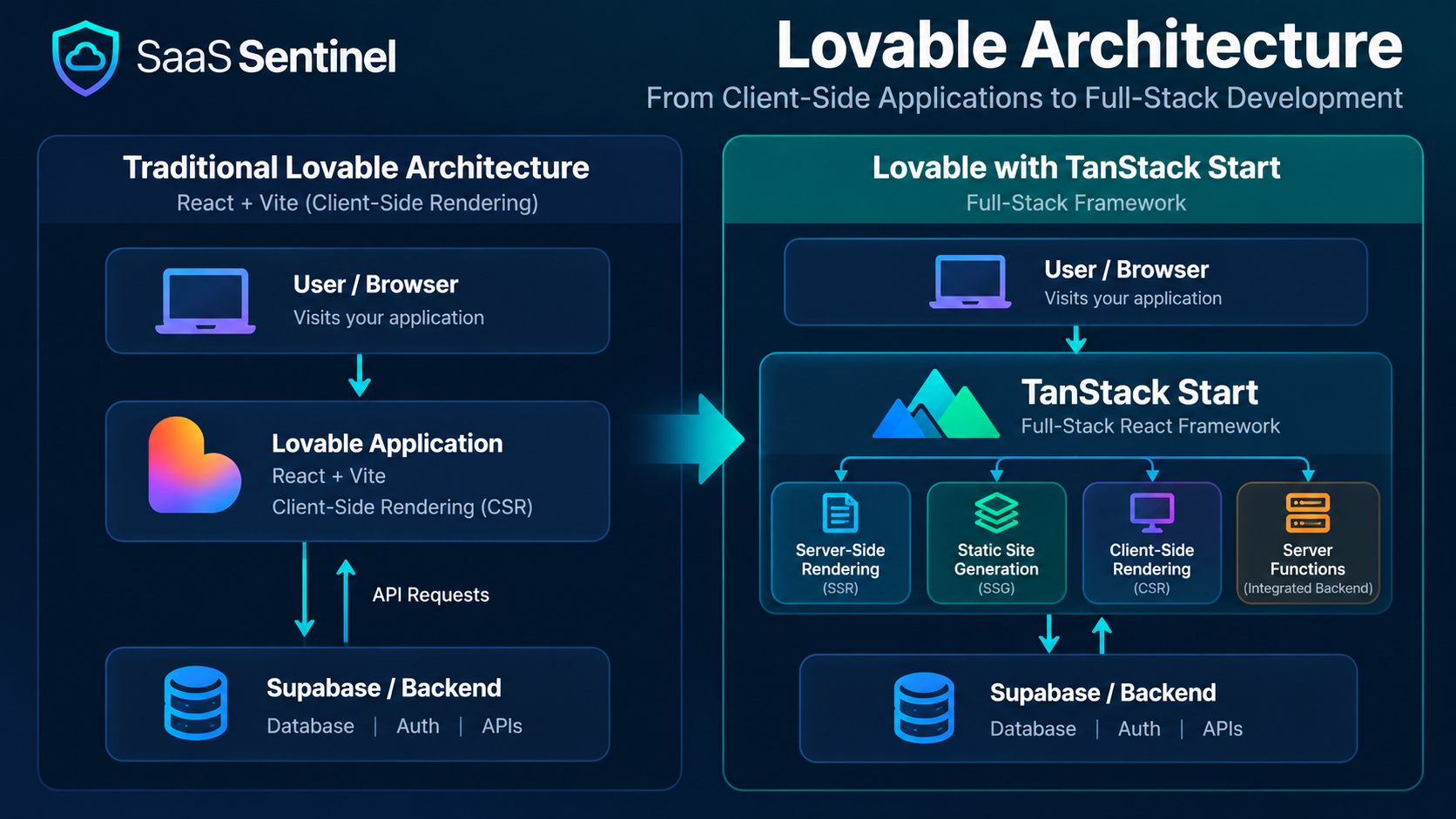
Historically, Lovable generated applications using React, Vite and React Router.
These applications operated primarily as Single Page Applications (SPAs), using Client-Side Rendering (CSR).
In simple terms, when someone visited an application, their browser downloaded the application code and executed it to generate the page.
This approach works particularly well for interactive applications, but it also introduces limitations.
Search engines may need to execute JavaScript before they can fully understand a page. Initial page rendering can depend heavily on the visitor's device and connection, while backend functionality generally requires separate services or functions.
Lovable's newer architecture uses TanStack Start, a full-stack React framework that supports several rendering approaches:
Server-Side Rendering (SSR): Pages can be rendered on the server before being delivered to the visitor.
Static Site Generation (SSG): Pages can be generated in advance and served efficiently.
Client-Side Rendering (CSR): Interactive application functionality can continue running in the browser.
Server Functions: Backend functionality can be integrated more closely with application code.
Importantly, these approaches can be selected according to the requirements of individual routes.
This provides considerably more flexibility than an application restricted to client-side rendering.
1. Improved Search Engine Optimisation
Perhaps the most immediately recognisable benefit of TanStack Start is improved support for search engine optimisation.
Traditional client-side applications can create challenges for search engines because the initial HTML document may contain relatively little meaningful content.
The browser must execute JavaScript before the complete page becomes available.
Although major search engines can process JavaScript, doing so can introduce additional complexity and delays.
With server-side rendering, search engines can receive meaningful HTML content immediately.
This can improve the accessibility of information such as:
Product descriptions and feature pages.
Pricing and subscription information.
Documentation and knowledge-base articles.
Public customer-facing pages.
Landing pages targeting specific industries or use cases.
For a commercial SaaS business, these are often the pages responsible for attracting new customers.
What About Existing Lovable Projects?
There is an important distinction here.
Lovable has already introduced pre-rendering for verified crawlers visiting existing applications.
This means older projects can benefit from improved search engine accessibility without migrating to TanStack Start.
However, moving to a framework with native SSR and SSG support gives developers greater architectural control over how individual pages are rendered.
For SaaS products with substantial public-facing content, this flexibility can become increasingly valuable.
2. Better Visibility to AI Search Engines
Traditional SEO is no longer the only consideration when developing a public-facing SaaS application.
Potential customers increasingly discover software through AI-powered services, including ChatGPT, Perplexity and other AI-assisted search experiences.
These systems need to discover, retrieve and understand information about products before they can accurately describe or recommend them.
Server-rendered content can make that information easier for compatible crawlers and retrieval systems to access.
For example, consider a SaaS application with pages explaining:
What the product does.
Which business problems it solves.
How it compares with alternatives.
Which integrations it supports.
Who the intended customers are.
Making this information available in accessible HTML can help reduce technical barriers to discovery.
However, server-side rendering does not guarantee AI visibility or recommendations.
Content quality, relevance, authority, crawl permissions and the information available to individual AI services remain important.
The advantage of TanStack Start is that it provides a stronger technical foundation for making public content accessible.
For SaaS companies investing in both traditional SEO and Generative Engine Optimisation (GEO), that is a worthwhile consideration.
3. Potentially Faster Initial Page Loading
Performance has a direct impact on the experience customers have when using an application.
With a traditional SPA, the browser often needs to download and execute JavaScript before the user can see the complete page.
Server-side rendering allows the server to generate the initial HTML before delivering it to the browser.
This can improve the speed at which meaningful content becomes visible, particularly for public-facing pages.
For a SaaS product, potential benefits include:
A better first impression. Visitors arriving at a product landing page may see useful content sooner.
Improved mobile experiences. Devices with limited processing power may benefit from receiving pre-rendered content.
More predictable initial rendering. Important page content can be delivered without waiting for all client-side application logic to execute.
However, SSR is not automatically faster in every situation.
Server response times, caching, JavaScript bundle sizes and application design all affect performance.
Authenticated dashboards with extensive client-side interaction may see less benefit than public marketing pages.
The important improvement is the ability to select the most appropriate rendering approach for each part of the application.
4. A More Integrated Backend Architecture
One of the most significant technical changes introduced by TanStack Start is support for integrated server functions.
Previously, Lovable applications commonly relied on separate Supabase Edge Functions for backend operations.
These remain useful, but separating application code from backend functions can introduce additional development and maintenance complexity.
TanStack Start allows server-side functionality to be defined more closely alongside the application code.
Consider a SaaS application that needs to:
Call a third-party API using a private API key.
Process subscription information.
Retrieve confidential customer data.
Perform calculations that should not run in the browser.
Execute operations requiring elevated permissions.
These operations can be implemented using server functions rather than exposing the underlying logic to the client.
This can simplify application development and make the relationship between frontend functionality and backend processing easier to understand.
It also creates opportunities to reduce the number of separately deployed functions that need to be maintained.
For a growing SaaS application, architectural simplicity can translate into lower maintenance overhead.
5. Better Separation of Sensitive Operations
Security is particularly important for commercial SaaS applications.
Applications frequently process customer information, subscription data, authentication tokens and credentials for external services.
Sensitive operations should never depend on secrets embedded in browser-accessible code.
TanStack Start provides a clear separation between code executing in the browser and code executing on the server.
This makes it easier to design applications where sensitive operations remain within the server environment.
For example, a SaaS application integrating with a third-party service can use server functions to make authenticated API requests without exposing the service credentials to the browser.
However, migrating to TanStack Start does not automatically make an application secure.
Developers must still implement appropriate authentication, authorisation, input validation, tenant isolation and secret management.
The framework provides better architectural options, but security remains an application design responsibility.
For multi-tenant SaaS products, this distinction is particularly important.
6. A Stronger Foundation for Growing SaaS Applications
Many Lovable projects begin as prototypes or Minimum Viable Products (MVPs).
The initial objective is usually to validate an idea and demonstrate that the application can solve a problem.
Once customers begin using the product, the priorities change.
The application may need to support more users, additional integrations, more sophisticated permissions and increasingly complex business processes.
TanStack Start provides a flexible foundation for this evolution.
Different parts of the application can use different rendering strategies.
For example:
Application Component | Potential Rendering Approach |
|---|---|
Public marketing website | SSR or SSG |
Product feature pages | SSR or SSG |
Documentation | SSG or SSR |
Customer dashboard | CSR or SSR |
Interactive reporting | CSR |
Secure backend operations | Server Functions |
This flexibility allows developers to optimise different parts of the application without forcing everything into the same architectural model.
It does not eliminate the need for good database design, infrastructure planning or application monitoring.
Nevertheless, it provides more options as the application becomes increasingly sophisticated.
7. Improved Maintainability and Development
Another benefit of TanStack Start is its emphasis on type safety and a more integrated development model.
TanStack Router provides strongly typed routing, while the framework supports type-safe interactions between client and server code.
These capabilities can help developers identify certain errors earlier in the development process.
They are also particularly relevant when applications are being generated and maintained using AI-assisted development tools.
Clearer interfaces and stronger type checking provide useful constraints for AI-generated code.
As SaaS applications grow, maintainability becomes increasingly important.
An application that was initially developed in a few days may eventually contain hundreds of components, numerous integrations and complex business logic.
A well-structured framework can help reduce the technical debt associated with that growth.
However, adopting a new framework is not a substitute for reviewing code quality, removing unnecessary dependencies and maintaining appropriate automated tests.
Should You Migrate an Existing Lovable Project?
The benefits of TanStack Start are attractive, but that does not mean every existing Lovable application should immediately migrate.
The decision should depend on the application's purpose, maturity and technical requirements.
When Migration May Make Sense
Migration is worth considering when:
Your application depends on organic discovery.
If public-facing pages are an important source of new customers, native SSR and SSG capabilities may justify moving to the newer architecture.
Your application has increasingly complex backend functionality.
Integrated server functions may simplify the development and maintenance of functionality currently spread across multiple services.
You are planning significant new development.
A major product enhancement or architectural redesign may provide a suitable opportunity to adopt the newer framework.
You are experiencing architectural limitations.
If the existing application structure is making development increasingly difficult, migration could form part of a wider technical improvement programme.
When Staying With the Existing Framework May Be Better
There are equally valid reasons not to migrate.
For example, an internal business application that is only accessible after authentication may gain relatively little from server-side rendering.
Similarly, a stable SaaS product with an established customer base may not justify the cost and risk of changing its underlying framework.
Existing Lovable applications already benefit from crawler pre-rendering, so improved SEO alone may not justify migration.
In these situations, improving the existing application may deliver a better return on investment.
Migration Is Not Simply a Framework Upgrade
There is another important consideration.
Existing Lovable applications do not automatically become TanStack Start applications.
A migration may involve changes to routing, data loading, server-side functionality, authentication and deployment configuration.
It may also require reviewing dependencies that assume the application runs entirely in the browser.
Before attempting migration, developers should establish a clear understanding of the existing architecture.
A sensible approach includes:
Assess the existing application. Identify its routes, dependencies, integrations, authentication mechanisms and backend functions.
Define the expected benefits. Establish whether the objective is improved SEO, performance, maintainability or architectural flexibility.
Evaluate migration feasibility. Confirm the available migration approach and identify functionality requiring modification.
Create a recoverable baseline. Preserve the existing application, database configuration and deployment settings.
Test critical functionality. Pay particular attention to authentication, payments, customer data access and external integrations.
Validate the results. Compare performance, discoverability and application behaviour against the original implementation.
For a commercial SaaS application, preserving customer data and avoiding unnecessary disruption should take priority over adopting a newer technology.
At the time of writing, Lovable has described plans to bring more TanStack Start capabilities to existing projects. Developers should confirm the currently supported migration options before beginning work. See how Lovable migrated its own website to TanStack Start.
What Does This Mean for SaaS Founders?
The move to TanStack Start reflects an important development in AI-assisted application creation.
The conversation is moving beyond how quickly an application can be built.
Increasingly, the question is whether that application can be operated, maintained and developed as a sustainable commercial product.
For SaaS founders, this means thinking beyond the initial MVP.
Search engine visibility, application security, customer experience and long-term maintainability all contribute to commercial success.
TanStack Start provides useful capabilities in each of these areas.
However, the decision to migrate should be driven by business requirements rather than the availability of a newer framework.
A well-designed application running on the previous Lovable architecture may be preferable to a poorly executed migration.
Final Thoughts
Lovable's adoption of TanStack Start is a positive development for anyone building commercial SaaS applications on the platform.
The combination of server-side rendering, integrated backend functions, flexible routing and stronger type safety provides a more versatile foundation for developing modern applications.
For new projects, these capabilities are already part of the Lovable development experience.
For existing projects, migration deserves consideration—but not necessarily immediate action.
The most important question is not whether TanStack Start is technically better.
It is whether moving to TanStack Start will deliver measurable benefits for your particular SaaS application.
For SaaS founders, understanding that distinction can help ensure development effort is invested where it delivers the greatest value.
Frequently Asked Questions