


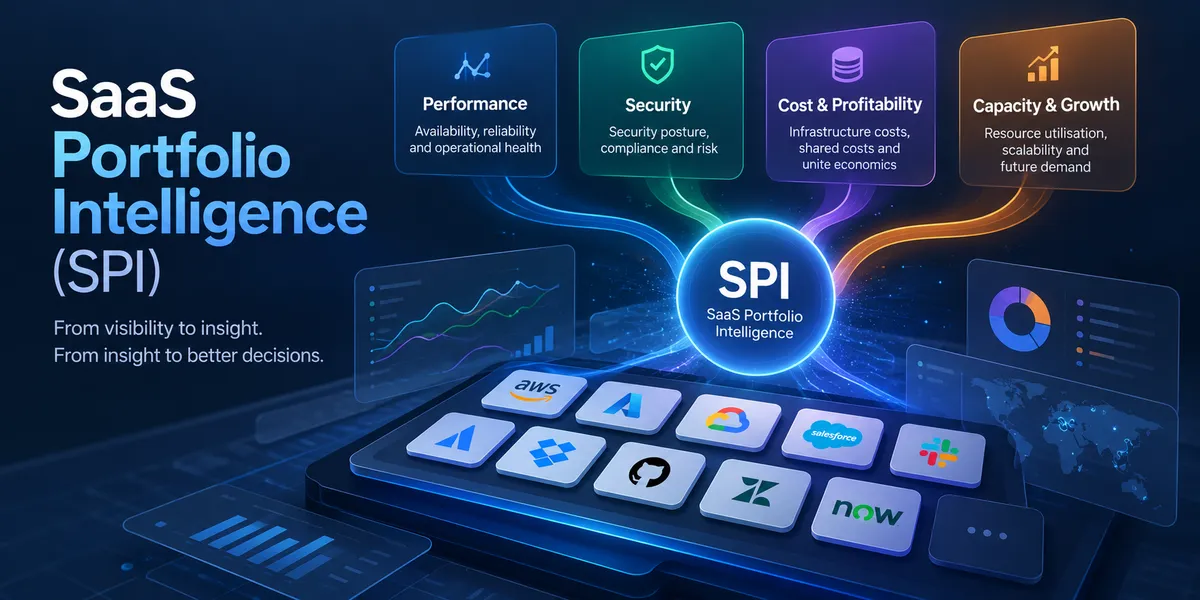
What Is SaaS Portfolio Intelligence (SPI)?
What Is SaaS Portfolio Intelligence (SPI)? Moving Beyond Operational Visibility
As SaaS businesses grow, knowing whether applications are running is no longer enough. SaaS Portfolio Intelligence brings together operational performance, security, financial analysis and capacity planning to help organisations manage their SaaS products as a portfolio rather than a collection of individual applications.
The Challenge of Managing Multiple SaaS Applications
When you operate a single SaaS application, keeping track of its health, performance and costs is relatively straightforward.
Most cloud platforms and development environments provide built-in monitoring capabilities. You can check application availability, review logs, monitor database performance and track infrastructure consumption.
You probably know how much the application costs to operate, and you have a reasonable understanding of whether it is performing as expected.
But what happens when you operate five applications? Or ten? Or twenty?
Suddenly, the picture becomes considerably more complicated.
Each application may have its own infrastructure, database, monitoring tools, security configuration and billing arrangements. Some costs are directly attributable to individual applications, while others are shared across the entire portfolio.
Different applications may have different growth rates, resource requirements and commercial models.
And because information is spread across multiple systems, maintaining a consistent understanding of the entire portfolio becomes increasingly difficult.
The challenge is no longer simply monitoring individual applications.
It is understanding the operational and commercial health of the entire SaaS portfolio.
This is where SaaS Portfolio Intelligence comes in.
What Is SaaS Portfolio Intelligence?
SaaS Portfolio Intelligence (SPI) is the practice of combining operational, security, financial and capacity information across multiple SaaS applications to support better management and business decisions.
Rather than treating each application as an isolated technical environment, SPI provides a consolidated perspective on how the applications operate individually and collectively.
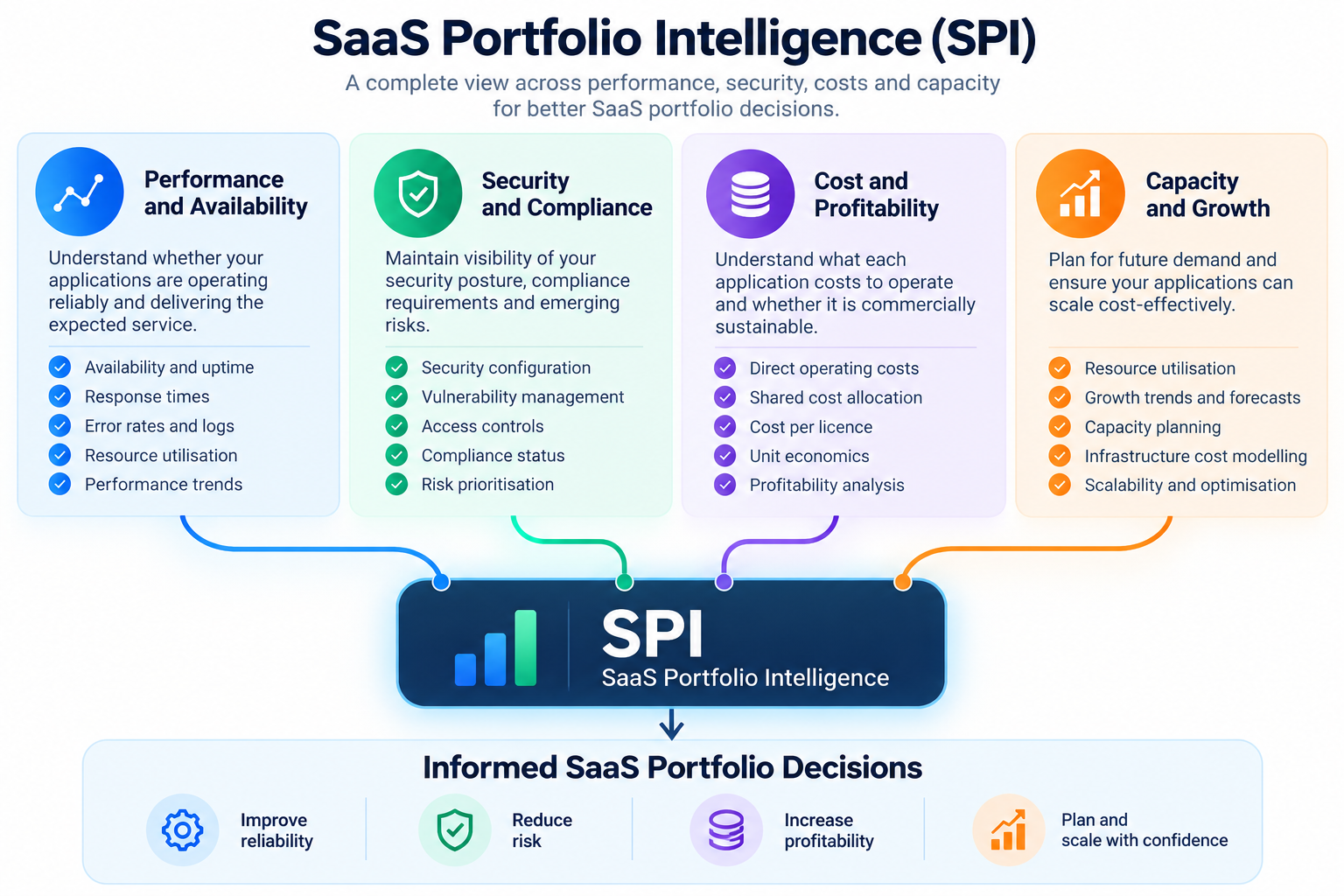
It connects four fundamental questions:
Performance: Are our applications available, reliable and performing as expected?
Security: Are our applications secure, compliant and appropriately protected?
Cost and Profitability: What does each application cost to operate, and is its commercial model sustainable?
Capacity and Growth: Can our applications support increasing demand, and what will that growth cost?
These questions are closely related.
For example, an application experiencing rapid customer growth might appear commercially successful. However, if its infrastructure costs are increasing faster than revenue, that growth could actually be reducing profitability.
Similarly, an application may demonstrate excellent availability while operating with insufficient capacity to accommodate its next significant customer.
Traditional monitoring tools can identify individual technical conditions.
SaaS Portfolio Intelligence connects those conditions with their broader operational and commercial implications.
From Operational Visibility to Operational Intelligence
Operational visibility and operational intelligence are related concepts, but they are not interchangeable.
Operational Visibility: What Is Happening?
Operational visibility provides information about the current state of an application or environment.
Typical capabilities include:
Application availability and uptime monitoring.
Infrastructure and database performance metrics.
Error rates and application logs.
Resource utilisation.
Security events and configuration status.
Service alerts and notifications.
These capabilities are essential.
Without reliable operational visibility, organisations cannot confidently determine whether their applications are functioning correctly.
However, visibility primarily tells us what is happening.
It does not necessarily explain the broader consequences.
Operational Intelligence: What Does It Mean?
Operational intelligence adds interpretation and context to operational data.
For example, monitoring might identify that database utilisation has increased by 30%.
Operational intelligence considers whether that increase is expected, whether it represents a developing capacity problem and what action might be appropriate.
It moves from simply collecting information towards supporting operational decisions.
SaaS Portfolio Intelligence: What Does It Mean for the Business?
SaaS Portfolio Intelligence extends this thinking across multiple applications and introduces financial and commercial considerations.
Consider the same database utilisation increase.
SPI encourages additional questions:
Is the increase associated with customer growth?
Will additional database capacity be required?
How much will that additional capacity cost?
How will it affect the application's cost per customer or licence?
Is the existing pricing model sufficient to maintain profitability?
Are similar capacity trends emerging in other applications?
Could shared infrastructure provide a more economical solution?
The difference is important.
Operational visibility tells you what is happening. Operational intelligence helps you understand what it means. SaaS Portfolio Intelligence helps you understand what it means for the health, scalability and profitability of your SaaS business.
The Four Pillars of SaaS Portfolio Intelligence
An effective SPI approach combines four areas that are frequently managed independently.
1. Performance and Availability Intelligence
The first requirement is understanding whether applications are operating correctly.
For SaaS providers, availability is fundamental to customer satisfaction and revenue protection.
However, simply knowing that an application is online is not sufficient.
An application might respond to health checks while customers experience slow transactions, database timeouts or intermittent errors.
Performance intelligence should consider:
Application and service availability.
Response times and transaction performance.
Database health and performance.
Error rates and recurring failures.
Infrastructure resource consumption.
Service dependencies.
Performance trends over time.
For organisations managing multiple SaaS products, consistency becomes particularly valuable.
Rather than checking several individual dashboards, a portfolio-level view makes it easier to identify applications requiring attention.
It also supports comparisons between applications and helps identify recurring operational problems.
The objective is not simply to know that applications are running, but to understand whether they are delivering the expected service.
2. Security and Compliance Intelligence
Every SaaS application introduces security responsibilities.
These may include authentication, access control, data protection, infrastructure configuration, vulnerability management and regulatory compliance.
As the number of applications increases, so does the complexity of maintaining consistent security standards.
One application might have strong authentication controls but outdated dependencies.
Another might have appropriate infrastructure security but excessive database permissions.
A third might be approaching the expiry of an important certificate or compliance requirement.
Security intelligence provides a consolidated understanding of these risks.
Relevant areas include:
Authentication and access controls.
Security configuration and posture.
Vulnerability and dependency management.
Data protection and encryption.
Certificate and credential management.
Compliance requirements.
Security events and emerging risks.
Importantly, security intelligence should help organisations prioritise issues based on their potential impact.
A critical vulnerability in a revenue-generating application handling sensitive customer information may require more immediate attention than a minor configuration issue in a development environment.
SPI provides the portfolio context needed to make those distinctions.
It also helps identify where security practices differ between applications, allowing organisations to establish more consistent standards.
The objective is to understand security and compliance risks across the entire portfolio, rather than discovering problems one application at a time.
3. Cost and Profitability Intelligence
This is one of the most important differences between traditional application monitoring and SaaS Portfolio Intelligence.
Cloud infrastructure is increasingly consumption-based.
Application costs can change as customer numbers increase, transaction volumes grow, storage requirements expand or third-party services are consumed.
For a single application, these costs may be relatively easy to identify.
Across a portfolio, the picture becomes more complicated.
Understanding Direct Costs
Direct costs are expenses attributable to a specific SaaS application.
Examples include:
Application hosting and compute resources.
Dedicated databases.
Storage and bandwidth.
Application-specific API consumption.
Transaction processing costs.
Dedicated monitoring or security services.
Application-specific third-party subscriptions.
These costs provide the starting point for understanding application economics.
Understanding Shared Costs
Many SaaS businesses also incur costs that support multiple applications.
Examples include:
Shared infrastructure.
Common authentication services.
Monitoring and observability platforms.
Security services.
Development and deployment tooling.
Shared API services.
Administrative and operational subscriptions.
These costs need to be allocated appropriately when calculating the true cost of operating individual applications.
Simply dividing shared expenses equally between products may not always be appropriate.
A more accurate approach may allocate costs based on usage, resource consumption, customer numbers or another relevant measure.
The important point is that shared costs cannot simply be ignored.
Understanding Cost per Licence
Once direct and allocated shared costs are understood, it becomes possible to calculate meaningful unit economics, or cost per license.
A simplified calculation is:
Cost per Licence = (Direct Operating Costs + Allocated Shared Costs) ÷ Active Billable Licences
For example, consider an application with:
Cost Component | Monthly Cost |
|---|---|
Hosting and infrastructure | £400 |
Database and storage | £150 |
API consumption | £100 |
Allocated shared services | £150 |
Total monthly operating cost | £800 |
If the application has 200 active billable licences:
£800 ÷ 200 = £4.00 per licence per month
If each licence generates £10 in monthly revenue, the application produces £6 per licence in contribution before other expenses not included in the calculation.
However, this is only the starting point.
The calculation becomes more valuable when examined over time.
What happens if infrastructure costs increase by 25%?
What happens if the customer base doubles?
Do costs increase proportionally with customer numbers, or are there economies of scale?
At what point will additional infrastructure investment become necessary?
These are commercial questions that cannot be answered through infrastructure monitoring alone.
Understanding Portfolio Profitability
A portfolio-level view also makes it possible to identify differences between products.
One application may have strong margins but limited growth.
Another may be growing rapidly but consuming increasing amounts of infrastructure.
A third may have low operating costs but insufficient revenue to justify continued investment.
Understanding these differences helps businesses decide where to invest, where to optimise and where pricing changes may be necessary.
SPI connects the technical cost of delivering SaaS services with the commercial value those services generate.
4. Capacity and Growth Intelligence
Capacity planning is often treated as a technical infrastructure exercise.
Traditionally, organisations monitor resource utilisation and increase capacity when thresholds are reached.
However, SaaS capacity planning has important commercial implications.
Increasing capacity generally increases costs.
Failing to increase capacity at the appropriate time can affect application performance, reliability and customer satisfaction.
SPI brings these considerations together.
Understanding Current Capacity
The starting point is understanding how existing resources are being consumed.
Relevant measurements might include:
Compute and memory utilisation.
Database connections and processing capacity.
Storage consumption and growth.
Network traffic.
API consumption and rate limits.
Transaction volumes.
Concurrent users.
Resource utilisation trends.
These measurements help establish whether applications have sufficient capacity to meet current demand.
Anticipating Future Requirements
Historical trends and business forecasts can then be used to estimate future requirements.
For example, an application may currently support 500 customers.
If customer numbers are expected to increase to 1,000 over the next six months, the business needs to understand whether the existing infrastructure can accommodate that growth.
If not, additional questions arise.
How much capacity will be required?
When should it be introduced?
What will it cost?
Will the additional investment affect profitability?
Could architectural changes improve scalability without proportionally increasing infrastructure costs?
Connecting Capacity to Commercial Planning
Consider an application that currently costs £1,000 per month to operate.
It supports 500 customers, giving an average operating cost of £2 per customer.
The business expects to double its customer base.
If infrastructure costs increase to £1,500 while customer numbers double, the operating cost per customer falls to £1.50.
That represents an improvement in unit economics.
However, if the additional demand requires a more expensive infrastructure configuration costing £2,500 per month, the cost per customer increases to £2.50.
Both scenarios involve successful customer growth.
But their commercial implications are very different.
Capacity intelligence helps SaaS businesses understand not just whether they can grow, but whether they can grow profitably.
Why Portfolio-Level Intelligence Matters
The individual components of SPI are not new.
Performance monitoring, security management, cost analysis and capacity planning have existed for many years.
What changes is the value of combining them across multiple SaaS products.
Consider a business operating six applications.
Each application may use different infrastructure components, databases, third-party APIs and subscription models.
The business needs to understand not only the health of each application, but also the collective operational and financial position.
Without a portfolio-level approach, several problems can emerge.
Fragmented Information
Operational information is distributed across different platforms and dashboards.
Obtaining a complete picture requires switching between systems and manually combining information.
Inconsistent Monitoring
Some applications receive regular attention, while others are reviewed less frequently.
This can lead to emerging problems being overlooked.
Unallocated Shared Costs
Shared services support multiple applications, but their costs are not consistently attributed.
As a result, individual application profitability may be overstated.
Reactive Capacity Planning
Infrastructure is expanded only after performance problems appear or resource limits are approached.
This can result in unnecessary urgency, unexpected expenditure and avoidable customer disruption.
Limited Commercial Insight
Technical metrics and financial information are managed separately.
Decision-makers struggle to connect application growth, infrastructure investment and profitability.
SPI addresses these challenges by establishing a more consistent framework for understanding the entire portfolio.
SaaS Portfolio Intelligence Is Not Just Another Dashboard
A dashboard can display information from multiple sources.
That is useful, but it does not automatically create intelligence.
The real value comes from connecting information that would otherwise be considered separately.
For example:
Application growth → Increased resource consumption → Higher operating costs → Changes in unit economics → Pricing or infrastructure decisions
Each stage influences the next.
A traditional monitoring dashboard may show increasing resource consumption.
A billing platform may show increasing infrastructure costs.
A subscription management system may show customer growth.
But understanding the relationship between all three requires additional analysis.
SaaS Portfolio Intelligence provides a framework for bringing these perspectives together.
It is ultimately about supporting decisions, not simply presenting more data.
Who Needs SaaS Portfolio Intelligence?
SPI is particularly relevant to organisations that develop, own or operate multiple SaaS applications.
SaaS Product Businesses
Businesses operating several SaaS products need to understand how each product contributes to the overall portfolio.
SPI supports operational oversight, investment decisions and profitability analysis.
SaaS Developers and Independent Software Vendors
Developers increasingly have access to platforms that make it possible to build and deploy applications quickly.
However, building an application is only the beginning.
As the number of deployed products increases, managing security, availability, costs and scalability becomes an ongoing responsibility.
SPI provides a framework for managing those responsibilities consistently.
SaaS Startups and Product Studios
Startups and product studios often operate with limited technical and financial resources.
Understanding which products consume resources, which generate sustainable revenue and where investment is required can be critical.
SPI helps connect technical decisions with business priorities.
Managed SaaS Operators
Organisations responsible for operating multiple SaaS environments can benefit from consolidated oversight.
Portfolio-level intelligence helps identify common risks, resource requirements and operational trends.
Introducing SaaS Sentinel: A Platform Built Around SPI
SaaS Sentinel was developed to address a practical problem.
Managing one SaaS application using its built-in tools is generally manageable.
But as the number of applications increases, important information becomes fragmented.
Some applications receive regular attention, while others are only checked when a problem occurs.
Costs become harder to allocate, particularly when infrastructure and services are shared.
Capacity planning becomes more complicated, and understanding profitability requires combining information from multiple sources.
SaaS Sentinel was created to help address these challenges across a portfolio of SaaS applications.
Its focus is on bringing together the four areas of SaaS Portfolio Intelligence:
Performance and Availability — Understanding whether applications are operating reliably.
Security and Compliance — Maintaining visibility of security posture and relevant risks.
Cost and Profitability — Understanding application operating costs, shared expenses and cost per licence.
Capacity and Growth — Understanding resource consumption and planning for future demand.
The objective is to make it easier for SaaS operators to understand the health of their portfolio and make informed decisions.
Rather than replacing every specialist tool used by an application, SaaS Sentinel provides a portfolio-level perspective.
It connects operational oversight with the financial and capacity considerations that determine whether SaaS products can operate sustainably.
The Future of SaaS Portfolio Management
The ability to develop and deploy SaaS applications continues to improve.
Cloud platforms, managed databases, low-code development environments and AI-assisted development tools have significantly reduced the effort required to bring new applications to market.
As a result, businesses and individual developers can build and operate larger portfolios of applications than would previously have been practical.
However, the operational responsibilities associated with those applications have not disappeared.
Every deployed product still requires attention to availability, security, cost management and scalability.
In fact, as the number of applications increases, these responsibilities become more complex.
The next challenge is therefore not simply building more SaaS products.
It is managing those products effectively, securely and profitably throughout their lifecycle.
SaaS Portfolio Intelligence provides a framework for meeting that challenge.
By combining operational, security, financial and capacity information, businesses can move beyond fragmented monitoring towards a more complete understanding of their SaaS operations.
Conclusion: From Visibility to Intelligence
Operational visibility remains essential.
Businesses must know whether their applications are available, secure and performing correctly.
But for organisations managing multiple SaaS products, visibility alone is no longer sufficient.
They also need to understand operating costs, shared expenses, unit economics and future capacity requirements.
These factors are interconnected, and decisions made in one area can have significant consequences elsewhere.
SaaS Portfolio Intelligence (SPI) brings these perspectives together.
It moves SaaS management beyond monitoring individual applications towards understanding the operational and commercial health of the entire portfolio.
The goal is straightforward:
Keep every SaaS product live, secure, scalable and profitable.
Discover SaaS Sentinel
SaaS Sentinel brings SaaS Portfolio Intelligence into a single platform, helping businesses understand and manage the applications they operate.
Explore SaaS Sentinel to learn how portfolio-level intelligence can support better operational and commercial decisions.
Frequently Asked Questions