


SaaS Licensing Models Explained: Which Is Right for You?
Choosing the right licensing model is about more than deciding what to charge. It determines how your SaaS business generates revenue, how customers experience your product, and whether your application can grow profitably.
When developing a SaaS application, particularly using platforms such as Lovable, it is easy to concentrate on functionality, user experience and getting the product launched.
Pricing and licensing often come later.
But the licensing model you choose can have a significant impact on customer acquisition, infrastructure costs, recurring revenue and long-term profitability.
Should you charge per user? Offer different subscription tiers? Charge based on consumption? Or combine several approaches?
There is no single correct answer. The right model depends on your product, your customers and, importantly, how much it costs to deliver your service.
In this article, we introduce the most common SaaS licensing and pricing models, explain their advantages and limitations, and explore how to select an approach that supports sustainable growth.
Licensing and Pricing: What's the Difference?
Although the terms are frequently used interchangeably, licensing and pricing are not quite the same thing.
Your licensing model defines what customers are entitled to use. This might include the number of users, available features, usage allowances, managed devices or access to particular services.
Your pricing model determines how customers pay for those entitlements. This includes the amount charged, billing frequency, discounts, overage charges and any minimum commitments.
For example, a SaaS application might use a per-user licensing model, charging £15 per user per month, with a discount for annual commitments.
The licensing model is per user. The pricing model is a recurring subscription with volume-based billing.
Understanding this distinction makes it easier to design a commercial model that is both attractive to customers and financially sustainable.
The Most Common SaaS Licensing Models
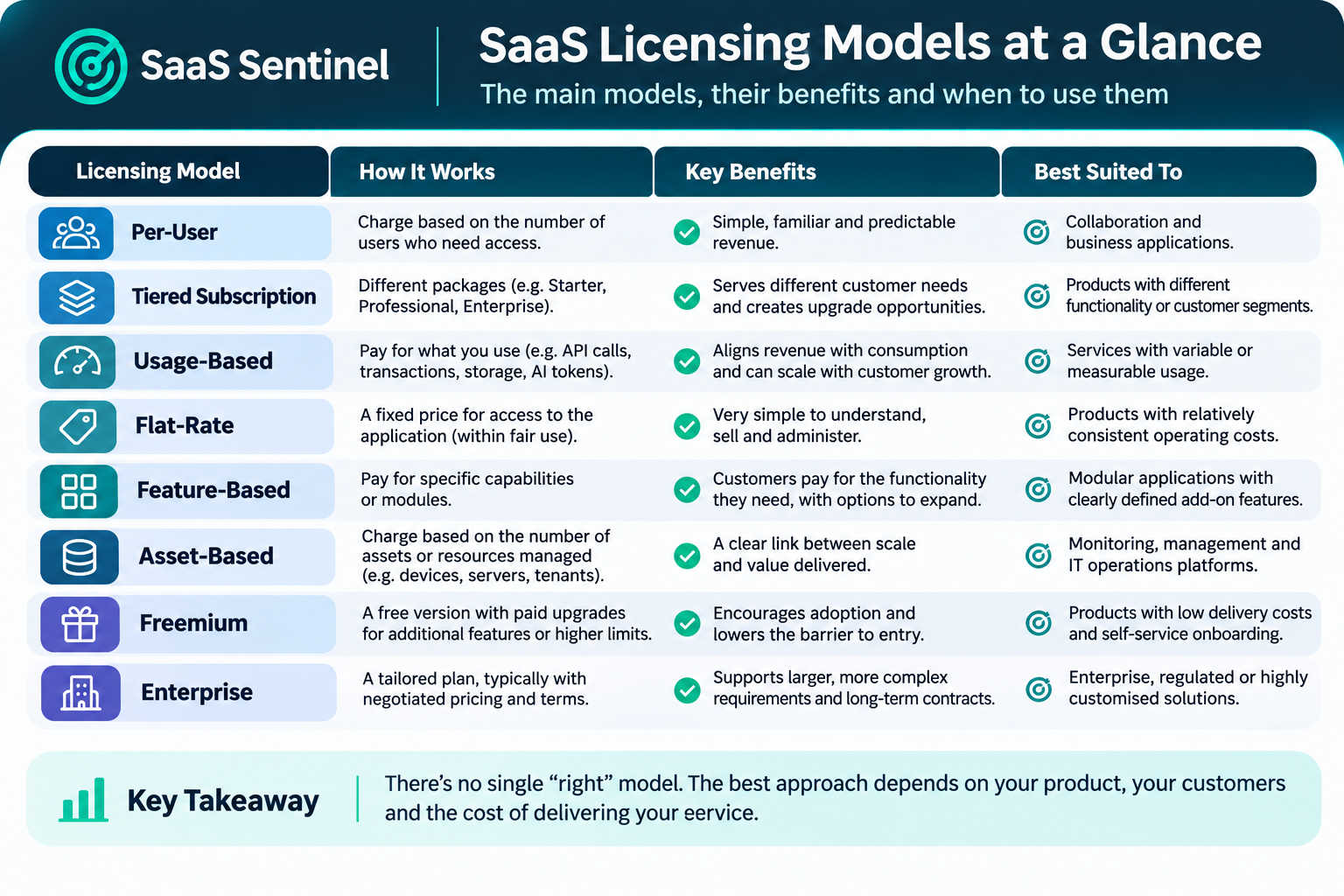
There are several established approaches to SaaS licensing. Each has advantages, limitations and different implications for revenue and operating costs.
1. Per-User Licensing
Customers pay according to the number of people who need access to the application.
This is one of the most familiar SaaS licensing models, commonly used for collaboration, productivity and business applications.
Advantages: Simple to understand, predictable recurring revenue and straightforward to administer.
Limitations: Can discourage customers from adding users, particularly where some users only need occasional access.
Best suited to: Applications where value increases with the number of active users.
2. Tiered Subscription Licensing
Customers select from different subscription packages, typically offering increasing levels of functionality, capacity or support.
For example, a SaaS product might offer Starter, Professional and Enterprise plans.
Advantages: Supports different customer segments, creates upgrade opportunities and makes it possible to serve both smaller and larger organisations.
Limitations: Poorly designed tiers can confuse customers or place important functionality behind inappropriate pricing barriers.
Best suited to: Products serving customers with different requirements, budgets and levels of sophistication.
3. Usage-Based Licensing
Customers pay according to how much of the service they consume.
Common measures include API calls, transactions, storage, AI tokens, processed documents or other measurable activities.
Advantages: Pricing can scale with customer consumption and align revenue with the underlying cost of delivering the service.
Limitations: Customers may find expenditure difficult to predict, while the SaaS provider must accurately measure and bill for consumption.
Best suited to: Applications where usage varies significantly between customers and where consumption can be measured reliably.
4. Flat-Rate Licensing
Customers pay a fixed amount for access to the application, regardless of the number of users or level of consumption, subject to any fair-use conditions.
Advantages: Very simple to communicate, sell and administer.
Limitations: Heavy users can become disproportionately expensive to support, reducing profitability.
Best suited to: Products with relatively consistent operating costs and limited variation in customer usage.
5. Feature-Based Licensing
Customers pay according to the capabilities or modules they require.
For example, a monitoring application might include basic availability monitoring in its standard package, with security analysis, advanced reporting or AI capabilities available as additional modules.
Advantages: Customers pay for the functionality they need, while the provider can monetise advanced capabilities.
Limitations: Too many optional features can make pricing complicated and create customer frustration.
Best suited to: Modular applications where customers have clearly different functional requirements.
6. Asset-Based or Resource-Based Licensing
Pricing is determined by the number of assets or resources being managed.
Examples include endpoints, servers, websites, domains, connected accounts or managed Microsoft 365 tenants.
Advantages: Provides a clear relationship between the scale of the customer's environment and the value delivered.
Limitations: The number of managed assets does not always reflect the actual cost of operating the service.
Best suited to: Monitoring, management, cybersecurity and IT operations platforms.
7. Freemium Licensing
A basic version of the product is available free of charge, with customers paying to access additional functionality, higher limits or enhanced services.
Advantages: Reduces barriers to adoption and allows potential customers to experience the product before purchasing.
Limitations: Free users still generate infrastructure and support costs, and conversion to paid subscriptions is not guaranteed.
Best suited to: Products with low marginal delivery costs, self-service onboarding and a clear upgrade proposition.
8. Enterprise or Contract-Based Licensing
Pricing is negotiated individually, typically based on customer size, requirements, service levels, integrations and contractual commitments.
Advantages: Supports larger commercial agreements, tailored services and potentially stronger customer relationships.
Limitations: Longer sales cycles, more complex contracts and additional administrative overhead.
Best suited to: Enterprise applications, regulated industries and solutions requiring significant configuration or integration.
Comparing SaaS Licensing Models
Licensing model | Revenue predictability | Cost exposure | Commercial complexity |
|---|---|---|---|
Per user | High | Medium | Low |
Tiered subscription | High | Medium | Medium |
Usage based | Variable | Often better aligned to consumption | Medium–High |
Flat rate | High | Potentially high | Low |
Feature based | Medium–High | Depends on feature usage | Medium |
Asset based | High | Depends on asset activity | Low–Medium |
Freemium | Low initially | Potentially high | Medium |
Enterprise contract | High during contract | Contract dependent | High |
These are general characteristics rather than fixed rules. Actual financial performance depends on pricing, usage limits, customer behaviour and the cost structure of the application.
You Don't Have to Choose Just One Model
Many successful SaaS businesses combine multiple licensing approaches.
For example, a SaaS monitoring platform might charge a base monthly subscription, include a specified number of monitored resources, offer higher tiers with additional functionality and charge for consumption beyond included allowances.
Similarly, an AI-powered SaaS application might combine per-user licensing with monthly AI usage allowances.
This hybrid approach can provide predictable recurring revenue while protecting the business against unexpectedly high consumption.
However, additional flexibility introduces complexity. Customers should still be able to understand what they are buying, what it costs and what might cause their bill to increase.
The objective is not to create the most sophisticated licensing model. It is to create one that customers understand and that allows the business to grow profitably.
The Critical Factor: Understanding Your Cost to Serve
One of the biggest mistakes SaaS founders make is selecting a price based primarily on competitor pricing.
Competitor pricing is useful market intelligence, but it tells you very little about whether your own application can operate profitably at the same price.
Consider two customers paying £50 per month.
One uses the application occasionally, generating minimal database activity and API consumption.
The other uses it continuously, consuming significant processing resources, storage and third-party AI services.
Under a flat-rate model, both generate identical revenue, but their contribution to profitability could be dramatically different.
Your costs might include:
Application hosting and infrastructure
Database storage, processing and bandwidth
Third-party APIs and AI model consumption
Authentication, messaging and other external services
Monitoring, security and operational tooling
Customer support and service delivery
Shared infrastructure costs must also be allocated appropriately when calculating the cost of delivering your service.
This is particularly important for SaaS applications developed using Lovable and Supabase, where infrastructure and service consumption can increase as customer adoption grows.
A pricing model that works well with ten customers may become financially unsustainable with a thousand if the underlying cost structure has not been properly understood.
For a deeper explanation, see our article on Calculating the True Cost per SaaS Licence.
How to Choose the Right SaaS Licensing Model
Before selecting a model, consider five questions.
1. What Are Customers Actually Paying For?
Identify the value your application delivers.
Is that value associated with individual users, managed resources, completed transactions, business outcomes or access to particular functionality?
Your licensing model should reflect the value customers recognise.
2. What Drives Your Operating Costs?
Determine which activities increase your costs.
If AI tokens, API calls or database processing represent significant variable costs, an unlimited flat-rate subscription may introduce unnecessary financial risk.
Where costs are relatively stable, simpler subscription models may be more appropriate.
3. How Predictable Do Customers Need Their Bills to Be?
Many business customers prefer predictable monthly or annual expenditure.
Consumption-based pricing can be attractive, but unexpected charges may create dissatisfaction.
Included allowances, spending caps and transparent overage pricing can help balance flexibility with predictability.
4. How Will Customers Grow?
Consider how your customers are likely to expand their use of the application.
Will they add users, connect more resources, consume more transactions or require additional functionality?
A good licensing model creates a natural relationship between customer growth and revenue growth.
5. Can You Measure What You Are Charging For?
A licensing model is only practical if the application can reliably measure and enforce the relevant entitlements.
Per-user licensing requires accurate user counts. Usage-based billing requires dependable consumption records. Feature-based licensing requires effective entitlement controls.
These capabilities should be considered during application design, not added as an afterthought.
Pricing Is Not a One-Time Decision
Your initial licensing and pricing model is unlikely to remain unchanged throughout the life of your SaaS business.
As the product evolves, you may introduce additional features, expand into new customer segments, adopt different infrastructure services or discover that actual customer usage differs from your original assumptions.
Regularly reviewing revenue, infrastructure costs, customer consumption and profitability allows you to identify when adjustments are necessary.
However, pricing changes should be managed carefully. Existing customers may have contractual commitments, established expectations or workflows that depend on the current model.
The objective should be to improve long-term commercial sustainability without unnecessarily damaging customer trust.
Where SaaS Sentinel Fits In
Choosing a licensing model is only the beginning. You also need to understand whether that model remains financially sustainable as your SaaS application grows.
SaaS Sentinel provides SaaS Portfolio Intelligence (SPI), bringing together operational visibility, infrastructure consumption, costs and capacity information to help SaaS owners make better decisions.
By understanding application operating costs, identifying changes in consumption and monitoring the resources supporting your SaaS portfolio, you can make more informed decisions about pricing, licensing and future investment.
This is particularly valuable when managing multiple SaaS applications, where different products may use different licensing models and have very different cost structures.
The objective is simple: keep your SaaS applications live, secure, scalable and profitable.
Conclusion: Choose the Model That Fits Your Business
There is no universally correct SaaS licensing model.
Per-user licensing may be ideal for collaboration software, while usage-based pricing may be more appropriate for API-driven services. Tiered subscriptions provide flexibility, and asset-based licensing can work particularly well for management and monitoring applications.
Many SaaS businesses will benefit from combining approaches.
The important thing is to select a model that customers understand, reflects the value delivered and supports sustainable profitability.
Before committing to a pricing structure, understand both what customers are willing to pay and what it actually costs to deliver your service.
A successful SaaS pricing model must work for the customer and the provider.
Frequently Asked Questions
Understand the economics behind your SaaS applications.
Explore SaaS Portfolio Intelligence at SaaS Sentinel.